
Reliability engineering is the practice of designing and maintaining equipment to ensure it performs exactly as it should, for as long as it needs to, without failing. It uses data and smart maintenance strategies to keep your assets running safely and efficiently, while significantly reducing unexpected breakdowns and long-term repair costs.
In the context of the rapidly modernizing industrial sector in India, “reliability” is often misunderstood as merely “not breaking down.” For the astute plant head, reliability is a measurable probability. To master it, one must distinguish between the three pillars of maintenance performance:
Consider “Company Alpha,” a chemical processing facility in Gujarat. For years, the team operated in a reactive cycle. Vibration issues in their centrifugal pumps were ignored until catastrophic failure occurred. They suffered from the “Maintenance Death Spiral”. Fixing one failure caused another, leading to increased parts consumption and erratic production schedules.
Most industrial failures in India – especially those subject to high ambient temperatures, humidity, and fluctuating power grids, follow specific patterns. While the classic “Bathtub Curve” (mortality, random failure, wear-out phase) is the theoretical baseline, modern reliability engineering acknowledges that most failures are age-independent (random). They are driven by stressors rather than just time-in-service.
True reliability engineering shifts the focus from “repairing machines” to “managing assets.” It requires a cradle-to-grave mindset where design choices, installation standards, and operating procedures (SOPs) are integrated to maximize the Mean Time Between Failures (MTBF).
The cornerstone of modern reliability engineering in India is Reliability-Centered Maintenance (RCM). RCM is not a one-size-fits-all checklist, it is a structured framework (defined by the SAE JA1011 standard) used to determine the most effective maintenance tasks for any physical asset.
When Unit Alpha required intervention, ordering new parts wasn’t the first task on the list. Seven critical questions were first asked :
By mapping Failure Modes and Effects Analysis (FMEA), Unit Alpha stopped performing unnecessary “time-based” overhauls. They realized that opening a gearbox every 6 months to “check it” was actually introducing contamination, a leading cause of premature failure in industrial India. RCM allowed them to shift from “maintenance by calendar” to “maintenance by condition.”
Reliability engineering in industry is data-driven. Without diagnostics, you are guessing. At Hofincons, we deploy a stack of technologies that provide visibility into the P-F Interval -the time between the first potential sign of failure (P) and the functional failure (F).
Core Diagnostic Stack
By integrating these sensors into a centralized CMMS (Computerized Maintenance Management System) or EAM (Enterprise Asset Management) platform, we provide maintenance teams with a “control tower” view of the plant.
Result: In a recent deployment of these technologies, we observed that equipment failures reduced by 30% within the first 12 months.
Before vs. After Scenario:
Reliability engineering is often viewed as a cost center, but in competitive markets, it is a significant profit driver. The business case for asset reliability optimization is built on four pillars:
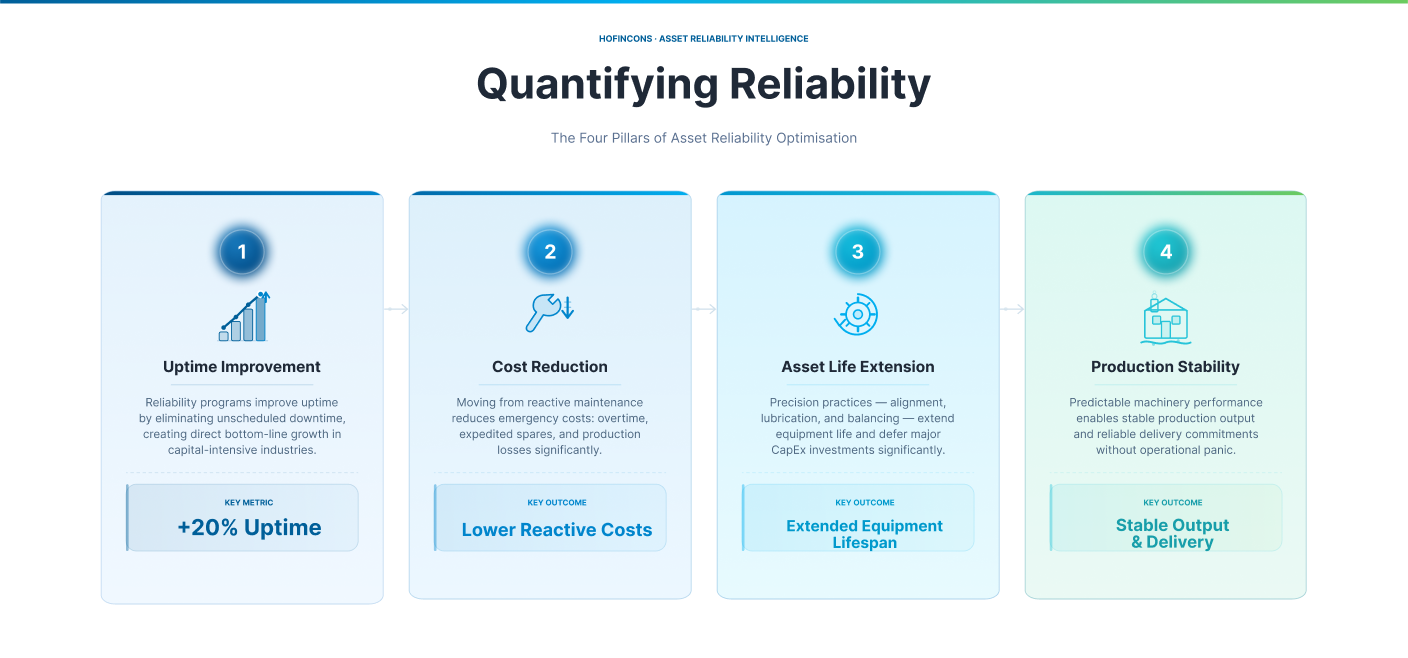
The Resolution at Unit Alpha: Within 18 months, the facility moved from a reactive firefighting mode to a controlled, predictive environment. Maintenance costs decreased by 15%, while total throughput increased by 12% due to consistent machine availability. The plant was no longer chasing failures; they were managing performance.
Hofincons provides the specialized expertise required to navigate the complexity of industrial maintenance. We don’t just provide labor; we provide a reliable partnership.
Our approach includes:
Whether you are looking to audit your existing strategy or build a predictive maintenance program from the ground up, Hofincons bridge the gap between engineering theory and industrial reality.
Explore our full suite of asset management solutions.