
Digital transformation within the industrial sector has moved past the era of software upgrades or simple cloud storage migration. Today, heavy industries, continuous processing plants, and manufacturing facilities face pressing macroeconomic challenges. Industrial operations teams are managing aging capital assets, stricter regulatory mandates, fluctuating material costs, and intense pressure to optimize operational expenditure.
In this landscape, achieving optimal asset longevity and maximizing overall equipment effectiveness require an architectural shift. Digital asset management in the industrial sector has emerged as a cornerstone of modern operational strategy. By converging the physical reality of the plant floor with cloud data platforms, enterprises can extract actionable insights from environments that were once isolated.
Recent market analytics indicate that this shift is accelerating rapidly. Industrial organizations deploying advanced automation frameworks are redefining their return on investment metrics. Globally, and specifically within the evolving industrial sectors of India, smart plant solutions are projected to grow exponentially through 2028. This growth is driven by the commercial availability of industrial 5G networks, low power wide area networks, and localized predictive analytics platforms.
For the modern chief technology officer or chief operating officer, understanding how artificial intelligence and the Internet of Things intersect with asset management is no longer optional. It is the definitive pathway to building a resilient, self-optimizing industrial enterprise.
To understand the modern factory floor, one must first address a fundamental question: What is digital transformation in industry? Industrial digital transformation is the comprehensive integration of digital technologies into all areas of a manufacturing or production enterprise. It fundamentally changes how the organization operates and delivers value to its customers. It represents a cultural and operational shift from traditional, reactive practices to data driven, autonomous ecosystems.
Historically, industrial maintenance and asset management relied on rigid, calendar based schedules or reactive interventions. Equipment was serviced either after a specific number of operating hours or after a catastrophic failure had already occurred. This approach introduces significant inefficiencies. It leads to the unnecessary replacement of healthy components or, conversely, unplanned downtime that halts production lines and incurs heavy financial penalties.
True digital transformation replaces these legacy practices by establishing a continuous loop of physical data collection, edge computing, centralized cloud analysis, and real-time operational execution. It unites information technology with operational technology. This convergence enables physical assets to communicate their exact health status, operational efficiency, and wear patterns directly to enterprise management systems.
In the context of modern asset management, digital transformation manifests as a structured framework built upon standardized asset data hierarchies. By aligning plant configurations with international standards such as ISO 14224 for reliability data and ISO 8000 for data quality, enterprises ensure that every sensor data point maps accurately to a specific component within a comprehensive asset taxonomy. This rigorous structural foundation prevents data fragmentation and ensures that analytical models operate on verified, high fidelity information.
The practical execution of industrial digital transformation relies on two primary technological engines: the Internet of Things and artificial intelligence. While IoT acts as the nervous system of the plant by capturing and transmitting physical data, AI serves as the brain, processing vast datasets to uncover hidden patterns and predict future events.
Understanding the role of IoT in maintenance requires looking at how data moves from a physical component to an engineer’s dashboard. Industrial machinery operates under extreme physical stress, generating distinct signatures in the form of vibration, heat, acoustic emission, and electrical consumption.
IoT predictive maintenance solutions deploy specialized, industrial grade sensors directly onto critical equipment such as high pressure pumps, turbines, compressors, and conveyor systems. These sensors capture high frequency physical variables continuously:
Once captured, this raw telemetry is processed at the edge by localized gateways to filter out ambient industrial noise. The refined data payloads are then transmitted securely via robust communication protocols, such as Long Range Wide Area Networks or industrial cellular networks, to a centralized enterprise asset management platform.
Once the IoT infrastructure establishes a steady stream of real-time telemetry, advanced analytics software takes over. CXOs frequently ask: How AI is used in asset management?
The answer lies in advanced pattern recognition and machine learning algorithms. Traditional maintenance software relies on static thresholds, triggering an alarm only when a parameter breaches a pre-set limit. By then, the asset is often already damaged.
Artificial intelligence introduces dynamic anomaly detection. Machine learning models ingest historical operational data to establish a highly precise baseline of normal behavior for each specific asset under varying load conditions and ambient environments. When live IoT sensor streams deviate even slightly from this multidimensional baseline, the AI flags the anomaly.
Furthermore, predictive AI models evaluate historical failure modes against current wear trends. This analysis allows the system to calculate the precise remaining useful life of a component and project an exact window of failure. This insight enables maintenance teams to schedule interventions during planned turnarounds, order required spare parts in advance, and avoid emergency supply chain costs.
The deployment of smart plant solutions India is rapidly moving from a luxury concept to a baseline operational requirement. Indian industrial sectors, including power generation, steel production, oil and gas refining, and continuous chemical processing, operate in demanding environmental conditions. These environments feature high ambient temperatures, variable power quality, and heavy atmospheric dust.
Localized smart plant solutions are uniquely engineered to withstand these operational realities. By utilizing edge computing gateways that process data locally, plants can maintain continuous asset monitoring even during temporary network connectivity drops.
In sectors like pharmaceuticals, where strict compliance with environmental parameters is mandatory, smart plant frameworks automate the tracking of cleanroom HVAC systems, refrigeration units, and processing vessels. This automation ensures a continuous, tamper-evident audit trail for regulatory bodies.
For executive leadership, investing in advanced technology must translate directly into clear financial and operational metrics. Implementing integrated AI and IoT asset management solutions delivers measurable improvements across multiple operational areas.
Unplanned maintenance is significantly more expensive than planned service due to emergency logistics, overtime labor, and secondary collateral damage to machinery. By transitioning from reactive or calendar based schedules to predictive interventions, enterprises optimize resource utilization. Industry data confirms that the strategic application of AI reduces maintenance costs by 20–30%. This reduction is achieved by eliminating premature component replacements, minimizing emergency repair expenditures, and streamlining maintenance labor allocation.
Traditional plant auditing relies on periodic manual inspections, which only capture a single moment in time and are subject to human error. Connected sensor networks provide an uninterrupted, high fidelity stream of asset health indicators. Deploying advanced IoT improves monitoring accuracy by 40%. This increased accuracy eliminates blind spots across distributed asset networks, allowing engineers to detect subtle operational degradation that manual checks would miss.
Overall Equipment Effectiveness measures three critical dimensions of production: availability, performance, and quality. Integrated smart plant solutions elevate all three metrics:
Modern industrial enterprises operate under intense scrutiny regarding safety, environmental emissions, and resource consumption. Automated data collection via IoT provides an unalterable, time-stamped record of energy usage, emissions compliance, and asset integrity status. This centralized data visibility simplifies compliance auditing and provides corporate leadership with the empirical data required for formal Environmental, Social, and Governance reporting.
While the financial and operational benefits of smart plant ecosystems are clear, industrial organizations often encounter complex technical and structural challenges during deployment. Identifying and addressing these hurdles early is essential for project success.
Many heavy industry plants operate capital assets that have been in service for decades. These legacy machines lack digital interfaces, native sensors, or standard communication protocols. Bridging the gap between legacy machinery and modern cloud intelligence requires a strategic approach to retrofitting. Organizations must select industrial grade, non-invasive external sensors capable of operating in harsh environments without altering the mechanical integrity or warranties of the host equipment.
A significant barrier to successful AI deployment is poor data quality, often caused by fragmented asset nomenclature across different plant sections or geographic locations. If the maintenance management system, the procurement database, and the factory floor control systems use different identifiers for the same spare part or equipment item, cross-platform analysis becomes impossible. Resolving this issue requires a comprehensive cleansing of asset master data, standardizing all descriptions, bills of materials, and parts catalogs against rigorous data governance frameworks before building predictive analytics pipelines.
Connecting previously isolated operational networks to enterprise IT systems and cloud environments introduces potential cybersecurity vulnerabilities. Industrial networks require stringent defense in depth architectures. This includes deploying unidirectional security gateways, enforcing strict data encryption at rest and in transit, isolating operational networks via demilitarized zones, and ensuring that IoT edge devices are equipped with secure, cryptographic authentication credentials.
Overcoming these structural and technical implementation challenges requires a partner that blends deep physical engineering experience with modern digital capabilities. Hofincons has established itself as a trusted partner in industrial operation and maintenance, asset management, and digital transformation services.
With decades of core domain experience across heavy industries, power sectors, refineries, and manufacturing environments, Hofincons understands that successful digital asset management cannot be achieved through software alone. It demands a profound understanding of machine dynamics, metallurgy, failure modes, and operational realities.
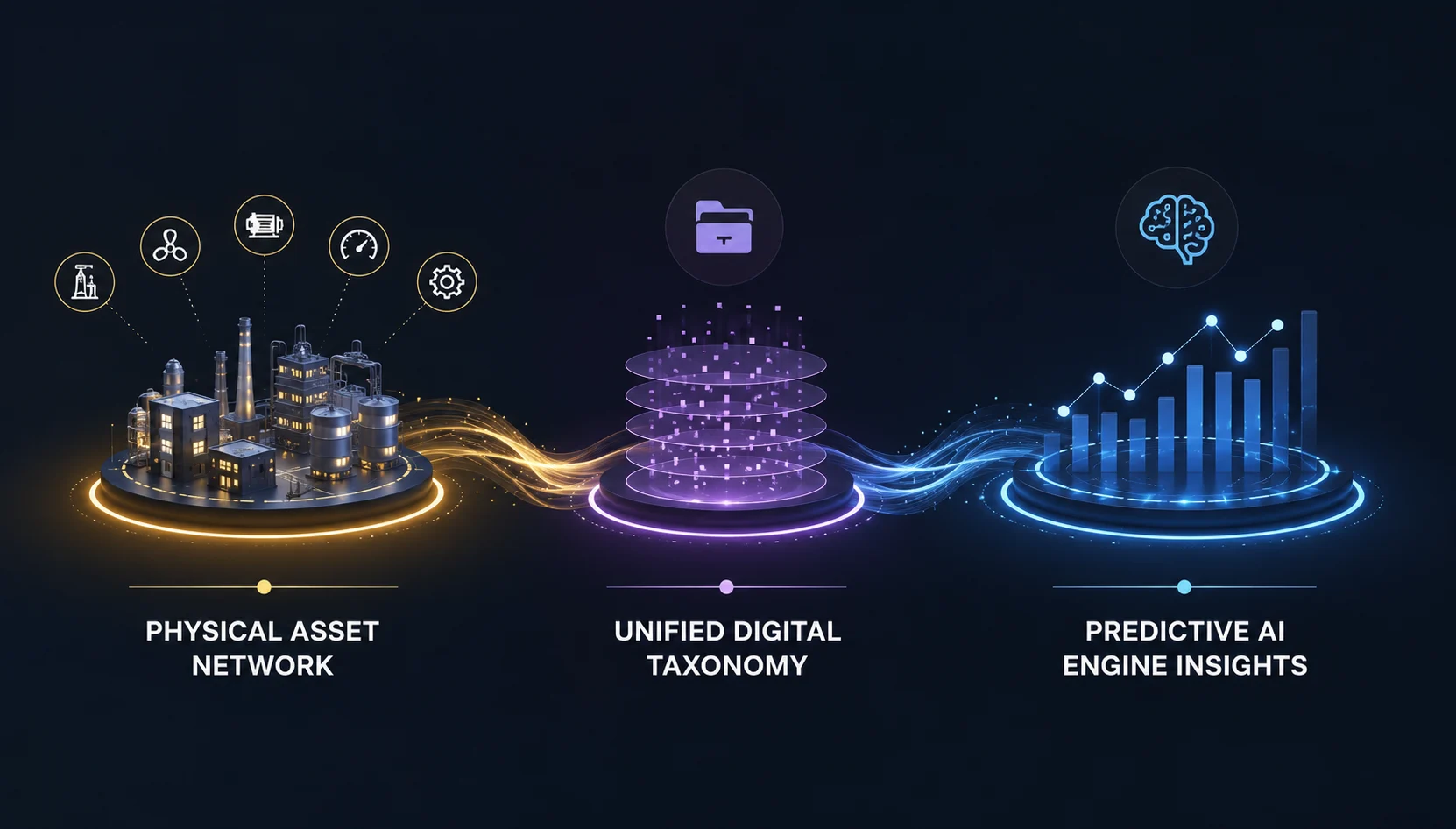
A successful transition to a smart plant architecture begins with data standardization. Hofincons assists enterprises in building a flawless digital foundation through comprehensive Asset Master Data management services. Utilizing their proprietary AIMS® IT suite, Hofincons enables organizations to clean, structure, and standardize complex asset taxonomies, equipment hierarchies, and spare parts catalogs. This process aligns existing data with global reliability standards like ISO 14224, ensuring that enterprise resource planning systems and computerized maintenance management systems can process analytical insights without friction.
To provide industrial organizations with a single, clear view of their distributed operations, Hofincons offers the AOne platform. This integrated digital solution acts as a centralized operational dashboard, linking real-time data from field sensors and IoT gateways directly into advanced analytical models.
By consolidating equipment performance tracking, dynamic predictive maintenance alerts, and overall asset health indexes into a single interface, the platform eliminates operational data silos. This centralized visibility empowers plant managers, reliability engineers, and executive leadership to make fast, data backed operational decisions, optimize maintenance schedules, and manage capital expenditures with high confidence.