
Industrial execution requires absolute operational precision. For asset-heavy industries such as power generation, steel manufacturing, chemical refining, and oil and gas processing, continuous production is the baseline requirement for profitability. However, maintaining the mechanical and technical integrity of complex plant assets demands periodic, highly structured intervention.
Among all operational responsibilities, managing a major asset intervention is the most resource-intensive and high-risk undertaking a plant management team will handle. Shutdown and turnaround management represents a critical intersection of project management, reliability engineering, and risk mitigation. When executed correctly, a turnaround preserves or improves overall equipment effectiveness. When planned poorly, the financial penalties can be severe
For leadership teams, executive managers, and chief operating officers, achieving a zero-downtime execution baseline requires shifting from simple time-based task lists to a comprehensive, data-driven lifecycle strategy.
Corporate operational audits indicate that unexpected operational delays and scope creep during interventions can quickly strain corporate budgets. Historical industry data demonstrates that poor shutdown planning increases costs by 20% over initial estimates. Conversely, an optimized turnaround reduces downtime by 15–25%, protecting production revenue and ensuring a right-first-time start-up.
For leadership teams, executive managers, and chief operating officers, achieving a zero-downtime execution baseline requires shifting from simple time-based task lists to a comprehensive, data-driven lifecycle strategy.
Defining the Operational Paradigm: Shutdown vs. Turnaround
To optimize complex interventions, organizations must establish a precise terminology framework. While field teams frequently use the terms interchangeably, distinct engineering and operational differences exist between a shutdown and a turnaround.
What is Shutdown Maintenance?
To address the foundational query: What is shutdown maintenance? Shutdown maintenance refers to the systematic process of stopping production activities to perform scheduled, routine maintenance tasks that cannot be safely or technically executed while the plant is fully operational.
A shutdown is primarily localized, short-term, and focused on maintaining steady-state operations. Examples include replacing worn conveyor belts in a cement plant, cleaning heat exchanger bundles in a chemical processing unit, or swapping out standard seals and gaskets. The main goal of shutdown maintenance is to return the specific operational section to its standard design parameters quickly, minimizing the interruption to production.
What is Turnaround Management?
A comprehensive approach requires looking at the broader scope: What is turnaround management? Turnaround management is a highly strategic, periodic, and full-scale project management framework that involves taking entire operating units or an entire industrial plant completely offline.
Turnarounds are long-term events that go beyond basic routine maintenance. They encompass an integrated blend of inspection, regulatory compliance verification, debottlenecking, capital modifications, and asset renewals. During a turnaround, heavy equipment is completely opened, cleaned, inspected for structural fatigue, and refurbished or upgraded. Turnarounds are highly complex because they require coordinating thousands of specialized work packs, large multi-disciplinary workforces, and substantial capital expenditures within a strict time window.
How to Plan a Plant Shutdown: The Execution Stages
Success or failure during execution is determined long before the first valve is closed. An effective strategy requires a structured, multi-phase methodology. For organizations analyzing how to plan a plant shutdown, the lifecycle breaks down into five distinct engineering phases.
Phase 1: Strategic Scoping and Milestone Setting
The planning process begins 6 to 12 months before execution. This phase establishes the exact boundary lines of the work scope. Plant leaders define the goals of the intervention, freeze capital improvement requests, and implement a rigorous work-justification process. Every proposed maintenance task must undergo technical evaluation: can this task be deferred to a routine outage, or does it absolutely require a full site outage? Freezing the scope early is the most effective defense against unexpected scope creep.
Phase 2: Detailed Preparation and Engineering Setup
Once the scope is finalized, engineering teams build the detailed work packages. This stage involves calculating necessary field resources, establishing precise step-by-step task sequences, and verifying tool and equipment availability. Materials management is critical during this phase. Every replacement asset, specialized component, and consumable item must be procured, quality-verified, and kitted for specific field teams.
Phase 3: Detailed Scheduling and Resource Leveling
Planners import the validated work packages into advanced project management software to establish the critical path. This phase involves setting up logical dependencies between tasks, balancing labor across multiple shifts, and identifying potential bottleneck areas. Resource leveling ensures that specialized engineering teams (such as high-pressure welders or instrumentation technicians) are utilized efficiently without creating idle time or scheduling conflicts.
Phase 4: Operational Execution and Live Coordination
During execution, the plant transitions from a production facility to a highly active construction and engineering site. Field managers track progress against the critical path in real time, conducting brief shift-turnover meetings to maintain momentum. Logistics tracking, materials deployment, and instant resolution of technical variations are vital to keeping field work moving forward on schedule.
Phase 5: Post-Turnaround Closeout and Re-Commissioning
The final phase begins with protocol-driven loop testing, dry runs, and formal safety pre-commissioning checks before introducing raw process materials. Once the plant safely returns to full operational capacity, the project team compiles detailed closeout reports. These logs document actual material consumption, actual labor hours, and technical deviations, capturing valuable data to improve future turnaround cycles.
Comprehensive Risk Management and Safety Compliance
Industrial interventions introduce unique operational hazards and technical variables. Managing a high concentration of personnel within enclosed processing environments requires strict adherence to comprehensive risk management frameworks.
Mitigating Critical Path Disruption
The critical path represents the longest sequence of dependent tasks that determines the minimum total time required to complete the project. Any delay to a critical path activity directly extends the total duration of the plant outage. Managing this risk requires dedicating senior engineering oversight to critical path nodes, such as primary turbine overhauls or furnace refractory replacements. Planners must establish rapid-response contingency protocols, ensuring that backup tooling and dedicated engineering support are stationed directly at these critical points.
Ensuring Stringent Safety and Environmental Controls
Outage environments feature increased risks related to working at heights, confined space entries, heavy lifting, and hot work. Organizations preserve workforce health by enforcing zero-compromise safety protocols. This includes implementing digital permit-to-work systems, conducting formal job safety analyses for every high-risk task, isolating hazardous energy sources through strict lockout-tagout procedures, and performing continuous atmospheric gas monitoring in enclosed process areas.
Cost Optimization and Material Management Strategies
A significant portion of turnaround expenditures can be traced back to inefficient materials tracking and poor logistics execution. Maximizing financial efficiency requires a disciplined approach to supply chain coordination.
Eliminating Tool Time Losses
Tool time represents the actual duration field technicians spend performing active maintenance tasks, as opposed to moving across the plant, waiting for permit approvals, or searching for replacement parts. Optimizing tool time requires setting up localized, pre-packaged material kits. By placing required gaskets, fasteners, specialized tools, and technical drawings into distinct, job-specific containers located near the equipment, organizations eliminate logistical delays and maximize field efficiency.
Standardizing the Bill of Materials
A common cause of turnaround delays is discovering that a critical internal component does not match the specifications listed in the legacy plant registry. Eliminating this risk requires conducting comprehensive data verification and master data enrichment well ahead of the shutdown window. Organizations must audit their bills of materials, confirm parts catalog accuracy, and ensure that procurement teams source certified, OEM-compliant components that match the specific asset configuration.
Optimizing Downtime: A Strategic Execution Example
To understand how structured planning limits downtime, consider the operational lifecycle of a primary continuous processing pump handling aggressive chemical media.
Under standard conditions, the pump operates continuously until a scheduled intervention window. In a traditional, un-optimized shutdown approach, maintenance teams wait for the asset to stop, unbolt the main housing, inspect internal components, identify a worn impeller, and then check the central warehouse for a replacement part. If the specific impeller is out of stock, the plant faces extended downtime while waiting for emergency procurement.
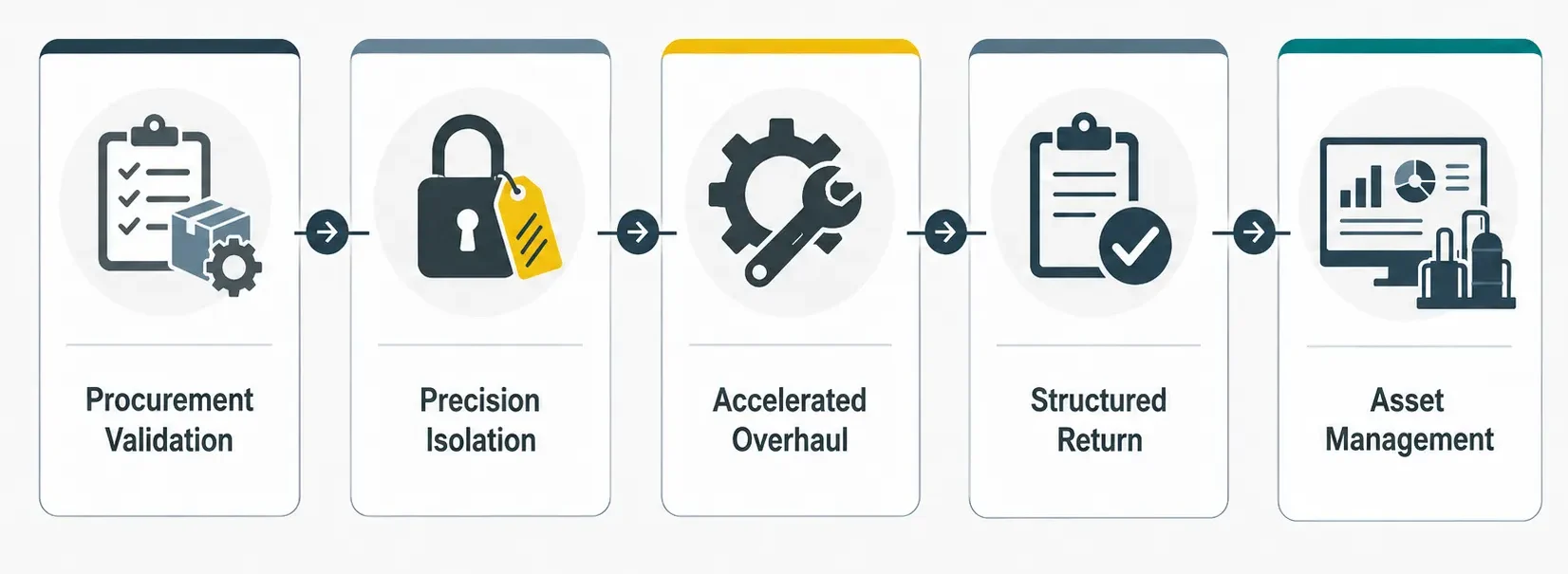
In contrast, an optimized turnaround management approach utilizes historic reliability analytics and precision planning. Months before the shutdown, engineering teams review the asset’s operating profile, verify component dimensions, and secure an OEM-certified replacement impeller.
The required component, along with matching high-temperature seals, fasteners, and calibrated torque wrenches, is organized into a dedicated, numbered container. As soon as the plant enters the shutdown window, the isolation sequence occurs smoothly, field technicians execute the component swap without any logistical delays, and the asset safely returns to service on schedule.
Technical Excellence in India: The Hofincons Execution Methodology
Executing complex, large-scale industrial interventions within tight timeframes requires a combination of deep engineering experience and structured project control. Hofincons has established itself as an experienced partner in providing comprehensive industrial operations, maintenance, and plant shutdown services India.
With over four decades of active field experience across major power infrastructure networks, large-scale metal refineries, and continuous chemical processing plants, Hofincons manages the entire shutdown and turnaround lifecycle with high discipline.
Turnkey Shutdown and Maintenance Services
Hofincons delivers complete, multi-disciplinary engineering capabilities that cover mechanical, electrical, and instrumentation systems. Their field teams manage full-scale plant shutdown services, equipment overhauls, and corrective maintenance interventions under strict adherence to technical parameters.
By deploying experienced, certified engineering professionals who understand specialized equipment mechanics, Hofincons ensures that every maintenance task, from high-pressure piping modification to precise control-valve calibration, meets rigid quality benchmarks. This engineering-led approach achieves reliable asset performance during re-commissioning.
Enhancing Reliability via the AOne Platform
To provide absolute transparency and maintain tight control over complex turnarounds, Hofincons utilizes the AOne platform. This integrated digital solution connects field personnel, tracking real-time milestone completions and safety compliance metrics on a unified operational dashboard.
By replacing manual tracking sheets with digital field status logs, the platform gives plant management immediate visibility into critical path progress. This real-time clarity enables quick operational adjustments, helps prevent scope creep, ensures efficient material deployment, and helps keep the turnaround on schedule to minimize overall plant downtime.
Asset Data Governance via the AIMS® Suite
A reliable turnaround relies on high-quality technical documentation. Hofincons assists organizations in refining their foundational data systems through their proprietary AIMS® IT suite.
Before a shutdown occurs, their teams analyze, clean, and enrich asset master data, ensuring that equipment hierarchies and bills of materials match the physical reality of the factory floor. This standardization helps maintenance planners build highly accurate work packages, identify safety-critical equipment, establish clear performance standards, and ensure that every spare part procured for the turnaround integrates correctly with core enterprise resource planning platforms.