
Industrial maintenance cost reduction is the strategic process of identifying and eliminating financial leaks within plant operations by optimizing equipment care and labor deployment. By transitioning from reactive repairs to a structured maintenance framework, enterprises can lower total operational expenses while simultaneously increasing plant productivity and safety standards.
Identifying Cost Leak Areas in Industrial Operations
Before an enterprise can implement a strategy for industrial maintenance cost reduction, it must identify where capital is being lost. In the Indian heavy industry sector, cost leaks are often distributed across several operational layers rather than a single line item. Understanding these leaks requires a granular look at how daily activities consume resources.
Unplanned Downtime and Emergency Repairs
When a critical asset fails unexpectedly, the costs go far beyond the price of the replacement part. Emergency repairs often involve expedited logistical fees for components, overtime pay for technical crews, and the loss of production revenue. In continuous process industries, an hour of downtime represents a direct impact on the bottom line. Furthermore, sudden failures can cause secondary damage to connected machinery, turning a small component failure into a massive systemic overhaul.
Inefficient Spare Parts Management
Many plants carry excessive inventory to hedge against potential asset failure. This ties up capital that could be used for other strategic investments. Conversely, a lack of critical spares leads to longer downtime. Without a logical approach to inventory, companies suffer from both high carrying costs and high stockout risks. In many Indian facilities, warehouses are often filled with obsolete parts for machines no longer in use, further draining resources through unnecessary storage and insurance costs.
Over Maintenance of Non Critical Assets
A common mistake is treating every piece of equipment with the same level of intensity. Performing high frequency preventive maintenance on a redundant or non critical pump is a misallocation of labor and materials. Maintenance optimization requires a clear understanding of asset criticality to ensure resources are focused where they provide the most value. Over maintenance also increases the risk of human induced failure, where frequent dismantling of functional equipment leads to errors in reassembly.
Strategic Maintenance Frameworks for Cost Control
To reduce plant maintenance cost effectively, a facility must adopt a mix of strategies tailored to its specific asset profile. There is no single best strategy; instead, there is a right strategy for each piece of equipment based on its role in the production chain. This tiered approach ensures that high value assets receive the most sophisticated care.
Preventive Maintenance
This involves performing maintenance tasks based on calendar time or run off hours. While it requires an upfront investment in labor, it is more cost effective than reactive maintenance. This approach helps in extending the life of assets and avoiding the catastrophic failures that lead to expensive emergency shutdowns. For Indian enterprises, this often means aligning schedules with seasonal production cycles to ensure the plant is at maximum health during peak demand periods.
Predictive Maintenance
This is a more advanced stage of maintenance optimization. By using condition monitoring tools such as vibration analysis and thermography, engineers can see the health of a machine in real time. This allows for an intervention only when the data indicates it is necessary, preventing the replacement of parts that still have functional life. It moves the conversation from what might happen to what is actually happening inside the machine.
Reliability Centered Maintenance
This process is used to determine the maintenance requirements of any physical asset in its specific operating context. It focuses on maintaining the functions of the equipment rather than the equipment itself. This methodology is essential for industrial O&M services India, where the goal is to maximize output while minimizing the input of labor and capital. It involves a rigorous analysis of failure modes and their effects on the overall plant safety and production targets.
ROI Breakdown: The Economics of Maintenance
Understanding the economic impact is crucial for justifying the shift toward professional industrial maintenance services. The transition from a cost center mindset to a value driver mindset requires looking at the total cost of ownership rather than just the maintenance budget.
Maintenance Strategy Impact Matrix
| Maintenance Mode | Impact on Labor Cost | Spare Parts Usage | Plant Reliability | Long term Impact |
|---|---|---|---|---|
| Reactive | High (Overtime) | High (Wasteful) | Unpredictable | Negative |
| Preventive | Managed (Fixed) | Managed | Improved | Positive |
| Predictive | Optimized (Planned) | Optimized | Maximum | High Value |
As shown in the matrix, the transition toward condition based monitoring directly correlates with lower labor and part costs. Maintenance optimization provides a clear path to improved profitability without requiring massive capital expenditure on new machinery. By focusing on these outcomes, plant heads can present a clear financial case to the board for upgrading their maintenance protocols.
The Link Between Maintenance and Productivity
Maintenance is a productivity driver. Reducing downtime increases the number of hours a plant can operate at its designed capacity. When equipment is maintained at its peak technical integrity, it operates more efficiently. This efficiency is seen in the consistency of the output quality, as well as the speed of the production line.
For example, a well maintained motor consumes less energy and generates less heat. In a large-scale industrial facility, the cumulative energy savings from a plant wide maintenance program can be significant, further contributing to the overall goal of industrial maintenance cost reduction. Additionally, a reliable plant reduces the stress on the operational workforce, leading to fewer errors and a more focused approach to production targets.
Technical Depth in Manpower and Labor Costs
Labor is often the largest variable expense in industrial maintenance. Reducing this cost does not necessarily mean reducing the number of people, but rather increasing the effectiveness of every hour worked.
Eliminating Wait Time
In reactive environments, maintenance crews often spend a large portion of their day waiting for parts or for the equipment to be released by the production team. Structured industrial O&M services India eliminate this waste through meticulous planning and scheduling. Every task is coordinated so that when a machine is stopped, the parts, tools, and people are ready to work immediately.
Specialization vs. Generalization
General labor is often insufficient for modern, complex industrial assets. While a generalist might be able to perform basic repairs, a specialist can identify the root cause of a recurring issue. By addressing the cause rather than the symptom, the specialist prevents the repair from being needed again in six months. This do it once, do it right philosophy is a primary driver of long term cost reduction.
How Professional O&M Services Enable Savings
Industrial O&M services India provide the technical expertise and management frameworks that internal teams may lack. By partnering with a specialized organization, an enterprise can adopt best practices developed across multiple industrial sectors. This cross industry knowledge allows for the application of proven solutions to unique plant challenges.
Skilled Manpower Deployment
One of the biggest challenges in the industrial sector is the shortage of highly skilled maintenance technicians. Professional service providers manage the recruitment, training, and deployment of experts who are proficient in modern diagnostic tools. This ensures that the maintenance work is done correctly the first time, preventing secondary failures and the need for repeated interventions.
Integrated Digital Tools
Modern maintenance relies on accurate data. Professional O&M providers bring software tools that integrate with existing Enterprise Asset Management systems. These tools provide a transparent view of every work order and every spare part used, allowing plant managers to make informed financial decisions based on real time reports rather than monthly estimates.
Performance Based Contracts
Unlike traditional manpower supply, professional maintenance services often operate under performance based agreements. This means the service provider is held accountable for specific outcomes, such as a reduction in unplanned downtime. This alignment of interests ensures that the provider is constantly looking for ways to improve efficiency, as their own success is tied to the performance of the plant.
Case Example: Optimization in Heavy Industry
Consider a large scale industrial mill operation where the primary objective is maximum throughput. In a traditional setup, the maintenance team might follow a rigid schedule, shutting down sections of the mill every month for inspection regardless of equipment health. This leads to forced downtime where machines are stopped even if they are functioning perfectly.
By implementing a maintenance optimization program, the team shifts to condition monitoring. Sensors placed on critical components track heat and vibration signatures. Instead of a blanket monthly shutdown, the team only intervenes when a specific component shows signs of wear that exceed a certain threshold.
The Resulting Impact:
- Labor Efficiency: Maintenance crews are only deployed for necessary tasks, allowing them to focus on high value activities like root cause analysis.
- Parts Preservation: Components are used for their full functional life, reducing the total volume of spares purchased annually.
- Production Gains: The mill remains operational for more days per year, increasing the total output and revenue of the enterprise without increasing the fixed cost base.
This shift from time based to condition based action is the cornerstone of industrial maintenance cost reduction. It represents a move toward a more intelligent, responsive way of managing heavy assets.
How Hofincons Reduces Operational Costs
Hofincons has spent over 45 years refining industrial maintenance practices. Our approach is built on the principle that maintenance should be a source of value, focusing on the longevity and efficiency of every asset under our care.
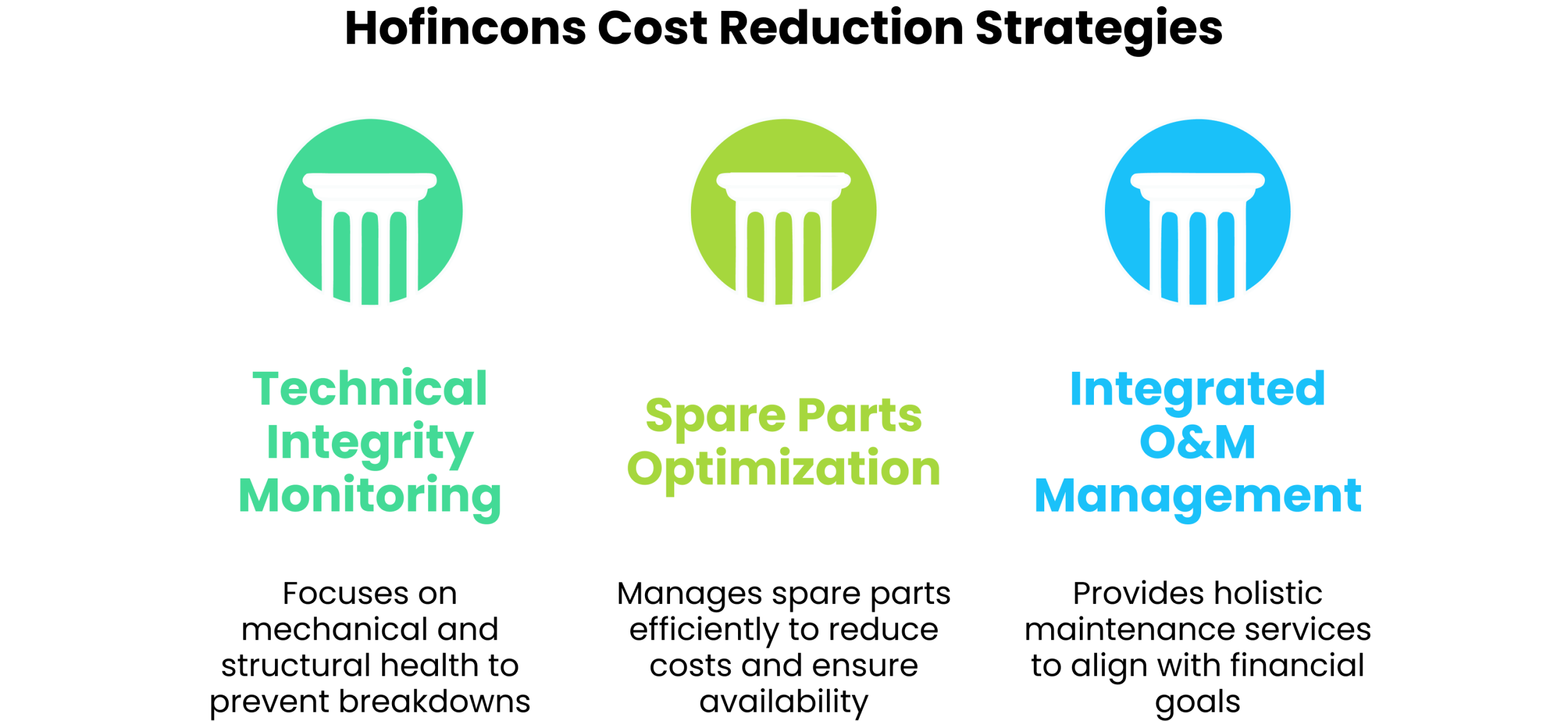
Technical Integrity Monitoring
We focus on the mechanical and structural health of your assets. By identifying potential points of failure before they manifest as breakdowns, we help our partners avoid the costs of emergency repairs and the risks associated with equipment failure. Our teams use advanced diagnostic equipment to provide a clear picture of asset health.
Spare Parts and MRO Optimization
Hofincons applies rigorous analysis to spare parts management. We help enterprises identify which spares are critical for immediate availability and which can be managed through just in time procurement. This optimization releases locked up capital and reduces warehouse costs, ensuring that the right part is always available at the right time.
Integrated O&M Management
In India, Hofincons – A Bluspring Enterprise, manages complex industrial sites through an integrated framework. We provide a managed service that includes engineering oversight, digital tracking, and continuous improvement protocols. This holistic approach ensures that every maintenance activity is aligned with the overall financial goals of the plant, from the smallest repair to the largest shutdown overhaul.